Sooner or later, the question of housing comes up in almost every conversation.
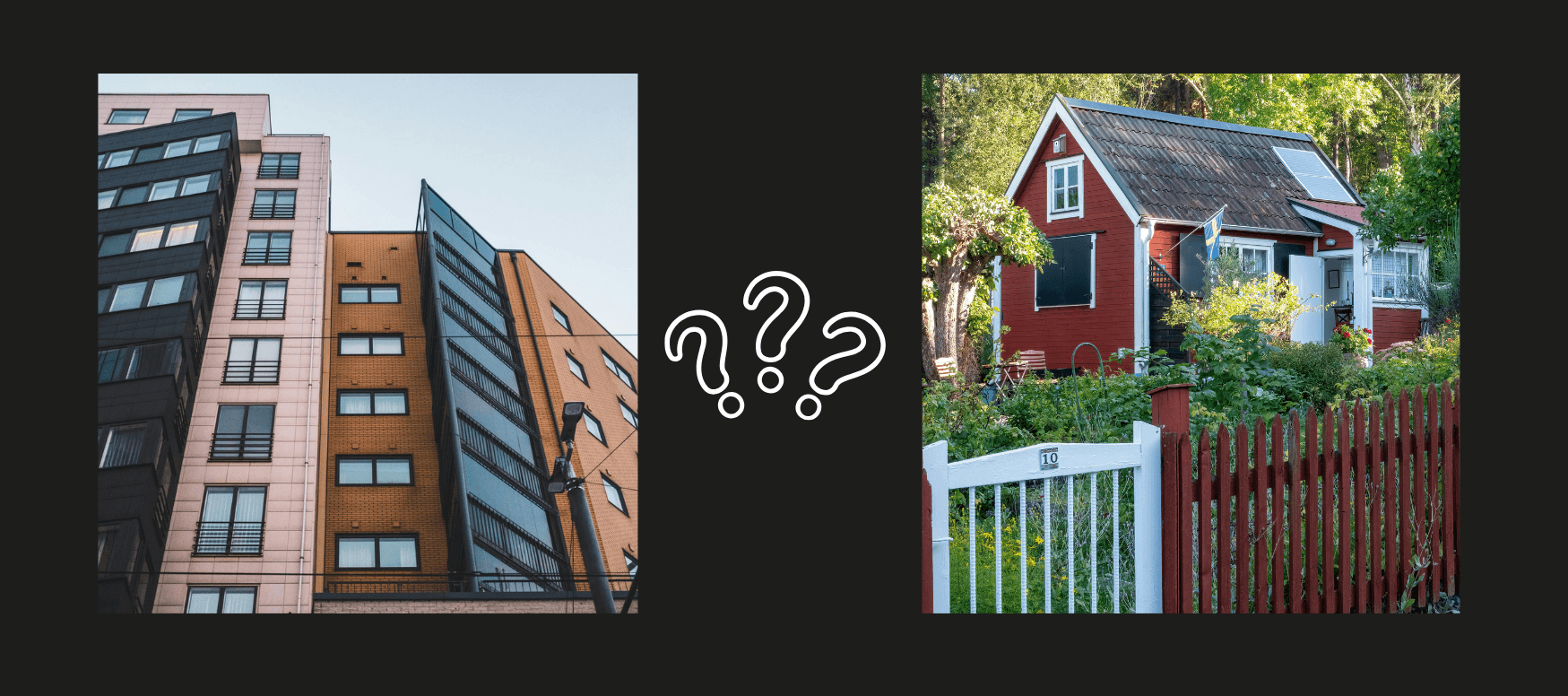
And not long after, it usually leads to the same dilemma: is it better to build a house or buy a flat?
Let's start with a simple calculation.
In a separate article, we calculated the total cost of building a 100 m² family house on the outskirts of Podgorica. You can see the full breakdown here:
👉 How much does it cost to build a house in Montenegro – 100 m² case study.
For roughly the same amount of money, in 2026 it is possible to buy a flat of about 70–75 m², typically a two-bedroom apartment, in an average location in Podgorica.
So how do these two options really compare?
1. Price
Based on the calculation above, in 2026 the cost of building a house on the outskirts of Podgorica is roughly €2,000 per m² (all-inclusive), while buying an apartment in an average location costs around €2,500 per m².
Of course, many factors vary: land prices, utility fees depending on location, construction and design costs depending on quality and level of finishes, and so on. Still, this represents a rough average.
Conclusion: the house is cheaper.
Score (Flat – House): 0–1
P.S. A very common mistake people make is this: they decide to build a house because it's cheaper, and then start behaving like millionaires - "since I'm already building, let's add three more rooms…"
The point is simple: a house is cheaper only if it has a similar surface area.
A 150 m² house is not cheaper than an 80 m² flat 🙂
2. Comfort
A house offers significantly greater living comfort than a flat: more privacy, more freedom, daily enjoyment of your yard, an always-available playground for children, and space for gathering with family and friends.
You will never circle the block looking for parking, nor worry whether it's too early or too late to turn on the vacuum cleaner. Many everyday chores become easier when you have a yard - from cleaning to cooking and beyond.
Score (Flat – House): 0–2
3. Access to City Functions
On the other hand, a flat will most likely be located within a 5-minute walk of a grocery store, pharmacy, and possibly a school (although it's not exactly common that new neighborhoods are actually planned with schools and kindergartens 😄).
You won't need to drive much to get to work or to the city center.
With a house, it's rare to find an affordable plot in a location where all these urban functions are equally close. In most cases, you'll need a car to reach everyday city amenities.
Score (Flat – House): 1–2
4. Adaptation to Personal Needs
In a house, everything can be done according to your wishes and ideas.
With a flat, no matter how carefully you choose it, and even with a good interior design project, certain compromises are unavoidable.
High ceilings, proper fireplaces, large balconies, generous spatial proportions… these are usually not even an option.
Score (Flat – House): 1–3
5. Investment Flexibility & Maintenance
A flat is definitely easier to sell or rent out. When it comes to houses, most people prefer to build their own rather than buy someone else's.
A house also requires higher maintenance costs. Keeping everything tidy, functional, and visually pleasant means more obligations and more work.
Score (Flat – House): 2–3
6. Health
In the race for more square meters and better locations, people often forget how much their living environment affects their health.
For a space to positively influence your body, it needs silence, good ventilation, proper sunlight, correct orientation of rooms, and materials that are not harmful. Greenery in the surroundings is also essential.
In theory, a well-designed apartment in a well-planned neighborhood could meet all these conditions. In practice, however, most buildings here are surrounded by parking lots and roads. When you open the window, dust comes in, and noise makes conversation difficult. Apartments are often single-oriented, making proper cross-ventilation impossible.
A house, being open on all four sides, allows for much better sunlight and airflow. Neighbors are far enough away to usually ensure peace and quiet. You'll likely have at least a small garden, a tree, or a vine, encouraging time outdoors in pleasant shade.
Add some physical activity from yard maintenance, and a house is clearly the healthier option.
Score (Flat – House): 2–4
7. Cleanliness
I still haven't met a sufficiently disciplined person who changes shoes every single time they come in from the yard.
A house offers the pleasure of enjoying a garden, but it also requires more cleaning if you want everything inside to stay spotless. Add terraces, the yard itself, outdoor areas… all in all, much more work.
Score (Flat – House): 3–4
8. "Hassle Factor"
If we exclude securing the finances (which is equally complicated in both cases), getting from idea to move-in is much simpler with a flat.
With a house, it's a different story: dealing with contractors, material procurement, construction mistakes, and delays becomes part of daily life.
Score (Flat – House): 4–4
If you want comfort and freedom, enjoy spending time in nature, don't mind dealing with construction, aren't afraid of contractors, like occasional gardening (be modern - replace the gym with yard work!), and are planning for the long term - **a house is for you. On the other hand, if you like to change apartments, cities, or even countries; if you're not a fan of building supply stores, soil on your hands, or cutting bushes and branches; if you enjoy having coffee in a bar on the ground floor of your building - buy a flat.
9. Security
One advantage of apartment living is that there are usually more people around. Neighbors, shared entrances, cameras, and the simple fact that someone is almost always nearby can make apartments feel safer, especially when traveling.
Houses offer more privacy, but they are also more isolated. If you travel frequently, you may need alarms, cameras, or someone checking the property.
Score (Flat – House): 5–4
10. Future Expansion
A flat is largely fixed. If your family grows, your options are usually limited to moving or undertaking major compromises.
With a house, there is often the possibility of adding a room, extending a terrace, building a garage, storage space, or even a guest apartment.
Life changes, and houses generally adapt to those changes more easily.
Score (Flat – House): 5–5
11. Energy Independence
Apartment owners depend entirely on shared infrastructure.
House owners have more opportunities to become partially independent through solar panels, batteries, rainwater collection systems, wells, fireplaces, heat pumps, and other solutions.
Most people may never use these options, but having the possibility can be valuable.
Score (Flat – House): 5–6
12. Noise
Even in high-quality buildings, you will occasionally hear neighbors, elevators, garage doors, renovations, or activity in common areas.
A house generally offers much greater control over noise levels and personal peace.
Of course, bad neighbors can exist anywhere, but distance is a powerful form of sound insulation.
Score (Flat – House): 5–7
13. Storage Space
One thing people consistently underestimate is how much storage they accumulate over the years.
Bicycles, tools, seasonal equipment, sports gear, children’s toys, gardening supplies, suitcases, Christmas decorations… the list never ends.
Most houses can accommodate these items much more comfortably than flats.
Score (Flat – House): 5–8
14. Architecture & Beauty
This may sound subjective, but the quality of the spaces we inhabit affects us every day.
A house allows complete control over proportions, views, outdoor spaces, natural light, landscaping, materials, terraces, and the relationship between indoor and outdoor living.
Even an excellent apartment usually involves compromises because it is only one part of a much larger building.
For people who value architecture and design, this is a significant advantage.
Score (Flat – House): 5–9
15. Garden & Growing Your Own Food
Even a small garden can change the way you live.
Fresh herbs for cooking, tomatoes that actually taste like tomatoes, fruit trees, a place for children to explore nature, a corner for reading, or simply the satisfaction of creating something with your own hands.
While some apartment buildings offer shared green areas, they rarely provide the same level of ownership and everyday connection to nature.
A garden is not just a piece of land, it is a lifestyle. Of course, it also requires time and maintenance, but for many people that is part of the enjoyment rather than a burden.
Studies consistently show that regular contact with greenery, gardening, and spending time outdoors can reduce stress, improve mental well-being, and encourage physical activity. A house naturally makes these things part of everyday life rather than something that needs to be scheduled.
Score (Flat – House): 5–10
Final Result
Score (Flat – House): 5–10
At first glance, it may look like the house wins easily.
However, notice something important: the apartment wins in areas related to mobility, convenience, liquidity, and simplicity, while the house wins in areas related to quality of life, comfort, health, freedom, and long-term living.
In other words, the apartment is often a better investment product, while the house is often a better living product.
That’s why there is no universal winner.
If your priority is flexibility, low maintenance, easy renting or selling, and staying close to urban life, a flat is probably the better choice.
If your priority is freedom, privacy, health, family life, outdoor space, and creating a home tailored specifically to your lifestyle, a house is probably the better choice.
And as always, don’t forget the most important rule:
A well-designed apartment is better than a poorly designed house.
A well-designed house is better than a poorly designed apartment. 😉